
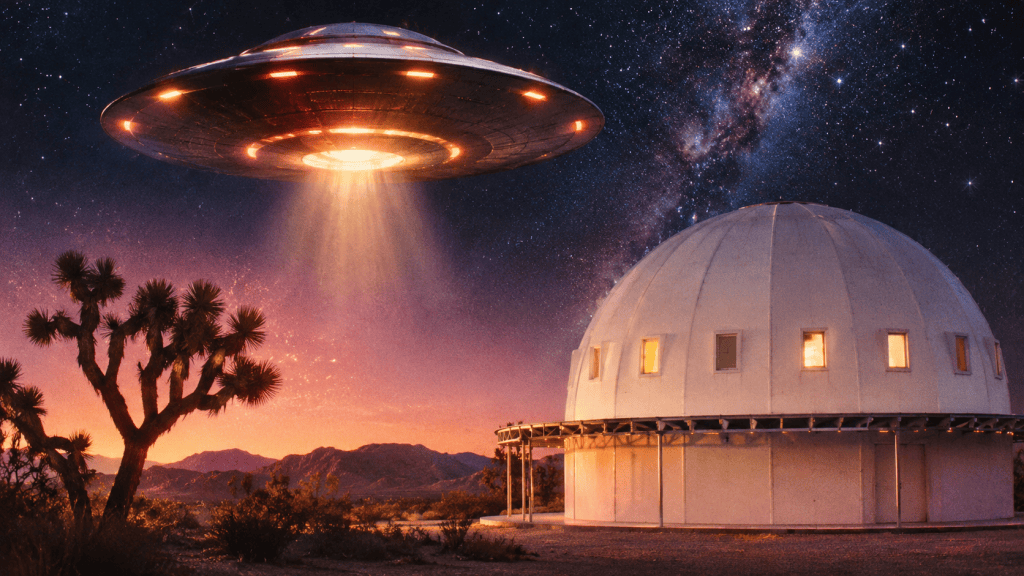
In the Mojave Desert, a former aviation worker claimed a visitor from Venus revealed the secrets of human rejuvenation. More than 70 years later, his strange wooden dome is still standing.
By Dusty Oddity | Desert Dispatch
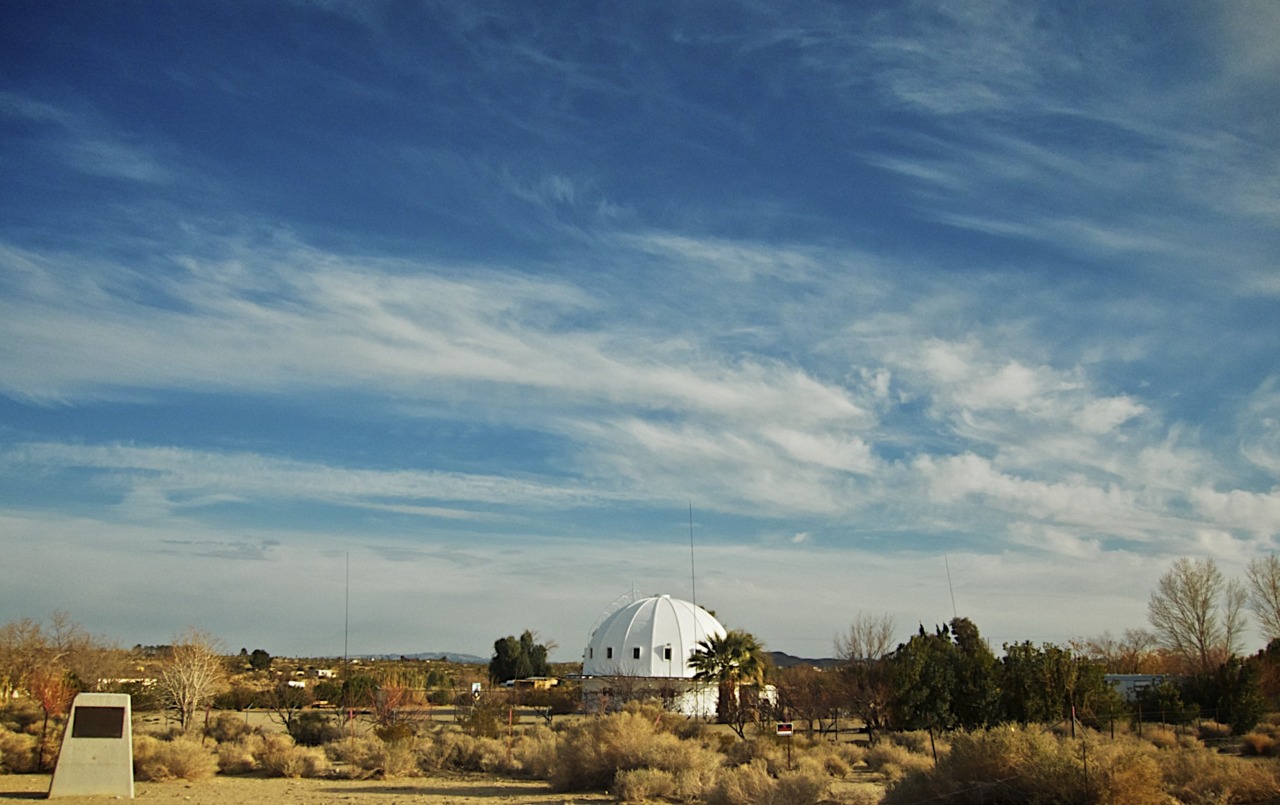
LANDERS, CALIFORNIA — Out past Joshua Tree, where the desert stretches toward the horizon like an unfinished thought, there’s a peculiar white dome sitting in the sand. It looks like a flying saucer landed upside down, decided it liked the neighborhood, and applied for permanent residency.
This is the Integratron.
And depending on who you ask, it’s either an architectural marvel, a monument to California’s golden age of UFO obsession, or the remains of an unfinished machine intended to reverse aging and investigate time travel.
That’s right. Aliens. Time travel. Eternal youth.
All the ingredients for a spectacular science-fiction movie, except somebody actually built the building.
His name was George Van Tassel, and his story might be one of the strangest chapters in the already gloriously weird history of the Mojave Desert.
Before the Aliens, There Were Airplanes
George Van Tassel wasn’t your typical desert mystic.
Born in Ohio in 1910, he worked in Southern California’s aviation industry during an era when aircraft technology was advancing at a dizzying pace. His career included work with Douglas Aircraft, Hughes, and Lockheed, although some of the more spectacular claims about his aviation accomplishments remain disputed.
In 1947, Van Tassel relocated with his family to Giant Rock, an enormous isolated boulder near Landers that had already acquired a reputation as one of the desert’s more unusual landmarks.
He operated an airstrip and café called the Come On Inn, catering to pilots, travelers, and the occasional adventurous soul who found themselves wandering through the Mojave.
Giant Rock was an appropriately strange place to establish a new life.
The massive boulder rises from the desert floor like something a prehistoric giant misplaced during a particularly ambitious game of marbles.
Beneath part of it, a prospector named Frank Critzer had excavated living quarters. Critzer died in 1942 during a confrontation with law enforcement in which explosives detonated at the site. The circumstances surrounding his death subsequently became entangled with local legend.
By the time Van Tassel arrived, Giant Rock already had enough peculiar history to keep a campfire conversation going until sunrise.
But the really strange stuff was just getting started.
A Visitor From Venus
According to Van Tassel’s account, everything changed in August 1953.
He claimed that an extraterrestrial being named Solgonda arrived at Giant Rock in a spacecraft and invited him aboard.
Solgonda, Van Tassel said, came from Venus.
Now, modern planetary science tells us that Venus is an extraordinarily hostile environment, with crushing atmospheric pressure and surface temperatures hot enough to melt lead.
Not exactly the sort of place you’d expect to find enlightened space philosophers handing out engineering advice.
But this was the 1950s.
Flying saucers were everywhere in the American imagination. The Cold War was heating up, atomic weapons had introduced humanity to the possibility of destroying itself, and science fiction was beginning to look suspiciously like tomorrow’s newspaper.
Into that atmosphere stepped Van Tassel, claiming that extraterrestrial visitors had shared advanced scientific knowledge with him.
Among the revelations, he said, were principles that could be used to rejuvenate human cells.
Not just slow aging down.
Reverse it.
Imagine telling your doctor that you’ve decided to skip the vitamins because a gentleman from Venus has a better idea.
Most physicians would probably have some follow-up questions.
Van Tassel, however, took the alleged encounter seriously enough to dedicate much of the rest of his life to building a machine around what he believed he had learned.
There is no independently verified evidence that Solgonda existed or that Van Tassel ever boarded an extraterrestrial spacecraft.
But the structure he built in pursuit of those claims is very real.
Building the Impossible
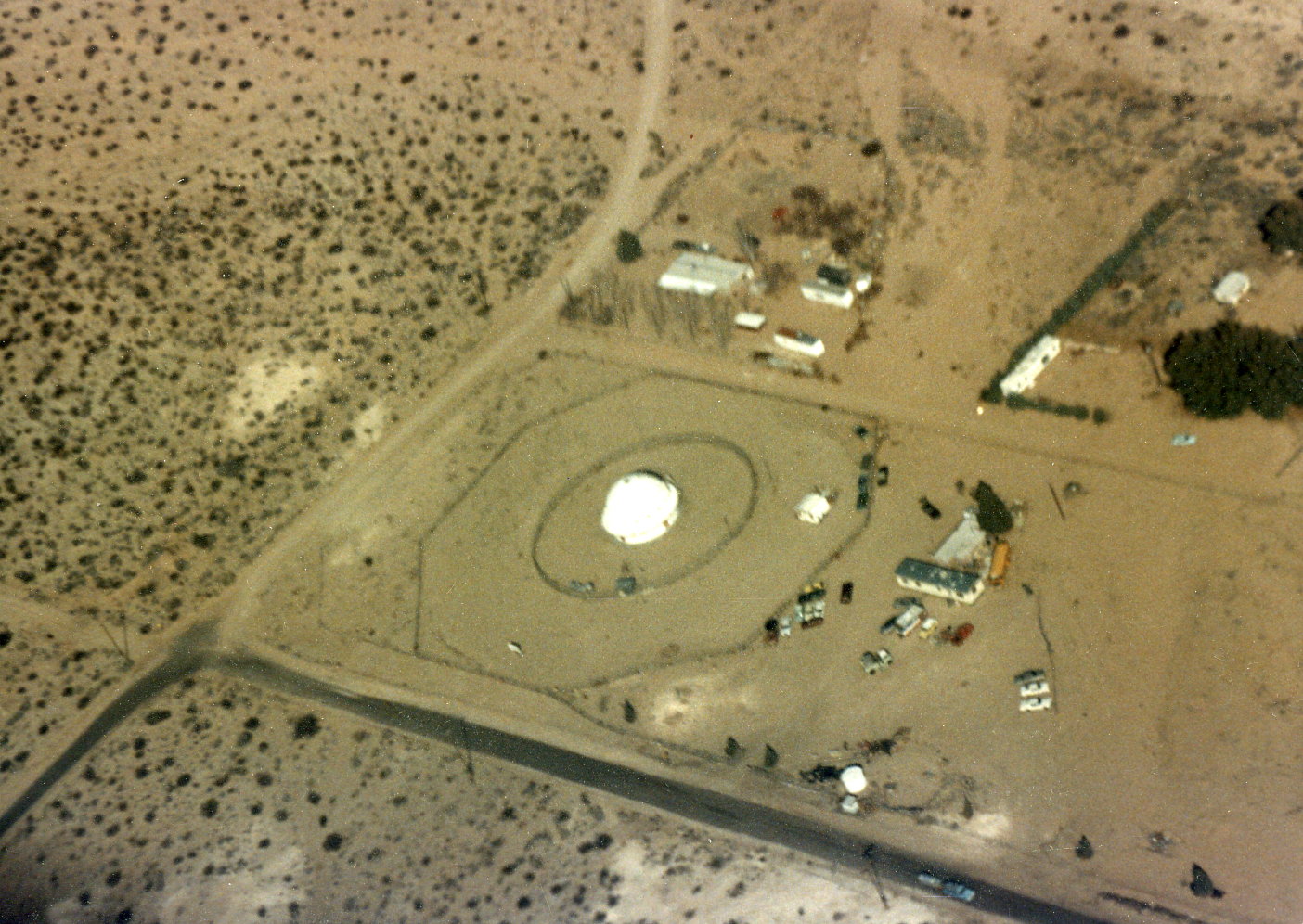
During the 1950s, Van Tassel developed plans for what would become the Integratron, working with architect Howard P. Hess, who formalized the building’s design in 1954.
Groundwork began later in the decade, with construction underway by 1958 and the primary structure completed around 1960.
Van Tassel continued working on the project for years afterward.
His proposed machine combined speculative electrical theories, electromagnetic concepts, and ideas about the relationship between energy and human biology.
He believed the structure could generate conditions capable of rejuvenating living cells, effectively restoring the human body like a rechargeable battery.
The project also incorporated ideas about time travel, although its central practical ambition was cellular rejuvenation rather than transporting people through history like some desert-built DeLorean.
The dome itself was an ambitious piece of architecture.
Approximately 38 feet tall and 55 feet in diameter, it was constructed around an intricate framework of laminated wooden arches. Its structural frame avoided metal fasteners, relying on wood and adhesive instead.
The building was intended to function as more than a shelter.
It was supposed to be an instrument.
Van Tassel envisioned specially controlled electrostatic forces interacting with the human body to restore youthful cellular function.
Unfortunately, there was one rather substantial problem.
Nobody had demonstrated that the underlying rejuvenation theory actually worked.
And despite decades of effort, Van Tassel never completed the machinery necessary to test his grand vision.
He died in February 1978, leaving behind a remarkable wooden dome, unfinished equipment, and an extraordinary collection of unanswered questions.
The machine never demonstrated that it could reverse aging or manipulate time.
But in a peculiar way, Van Tassel himself managed to reach the future.
His creation is still here.
Woodstock for Flying Saucers
The Integratron wasn’t Van Tassel’s only contribution to desert weirdness.
Beginning in 1953, he organized Interplanetary Spacecraft Conventions at Giant Rock, gatherings that continued for more than two decades.
And these weren’t tiny meetings of three guys sitting around a campfire arguing about Martians.
Thousands of people attended.
One convention in 1959 reportedly drew approximately 11,000 visitors.
There were UFO enthusiasts, self-described extraterrestrial contactees, spiritual seekers, curious families, and people who simply wanted to see what all the fuss was about.
Speakers shared stories of encounters with beings from other planets. Alternative theories about human history circulated alongside speculation about advanced technology and cosmic consciousness.
Some participants believed extraterrestrials were visiting Earth to prevent nuclear catastrophe. Others imagined humanity was approaching a new stage of spiritual evolution.
And some, presumably, just wanted to see a flying saucer.
It was part religious revival, part science-fiction convention, part countercultural gathering.
All of it unfolding beneath the relentless Mojave sun.
Long before Coachella became synonymous with desert festivals, Giant Rock was attracting crowds who came looking for an experience outside ordinary reality.
There were no celebrity DJs or luxury glamping packages.
Just cosmic enlightenment, questionable scientific theories, and a whole lot of dust.
Personally, I think the modern festival industry could learn something from that business model.
The Desert Has Always Attracted the Unusual

There’s something about the Mojave that seems to invite unconventional thinking.
Maybe it’s the isolation.
Maybe it’s the silence.
Maybe it’s the way the landscape strips away familiar distractions until you’re left alone with your thoughts, which can be a dangerous arrangement depending on what those thoughts are.
For generations, the Southern California desert has attracted religious visionaries, experimental artists, spiritual communities, inventors, survivalists, and people who simply didn’t fit comfortably into conventional society.
Van Tassel belonged to that tradition.
He wasn’t content merely to speculate about the universe.
He wanted to build something that would change humanity’s relationship with it.
His theories never achieved scientific validation, but the ambition behind them remains fascinating.
What kind of person looks at an empty patch of desert and decides to construct a machine that might defeat aging?
And what does it say about the rest of us that, decades later, we’re still drawn to the result?
From Rejuvenation Machine to Sound Baths
Today, the Integratron has found a second life.
Visitors travel to Landers to experience sound baths beneath its wooden dome, lying on mats while quartz crystal singing bowls produce sustained, resonant tones.
The building’s unusual acoustics are central to the experience.
Instead of seeking cellular rejuvenation through speculative electrical technology, guests come for relaxation, meditation, and the immersive sensation of sound moving through the space.
It’s a considerably more modest proposition than reversing the aging process.
But perhaps that’s part of the Integratron’s enduring appeal.
The building was created by someone who believed the universe contained possibilities far beyond accepted knowledge.
Today, people continue entering that same structure in search of experiences outside the rhythms of ordinary life.
In recognition of its unusual architecture and cultural history, the Integratron was added to the National Register of Historic Places in 2018.
That’s quite a transformation.
A structure conceived as an extraterrestrial-inspired rejuvenation machine is now a protected historic landmark and destination for immersive sound experiences.
The original scientific claims remain unproven. There is no credible evidence that the Integratron can reverse aging or manipulate time.
Yet its existence offers something genuinely worth contemplating.
A strange idea became a physical place.
And that place outlived the man who imagined it.
So, Did Aliens Really Build a Time Machine in the Desert?
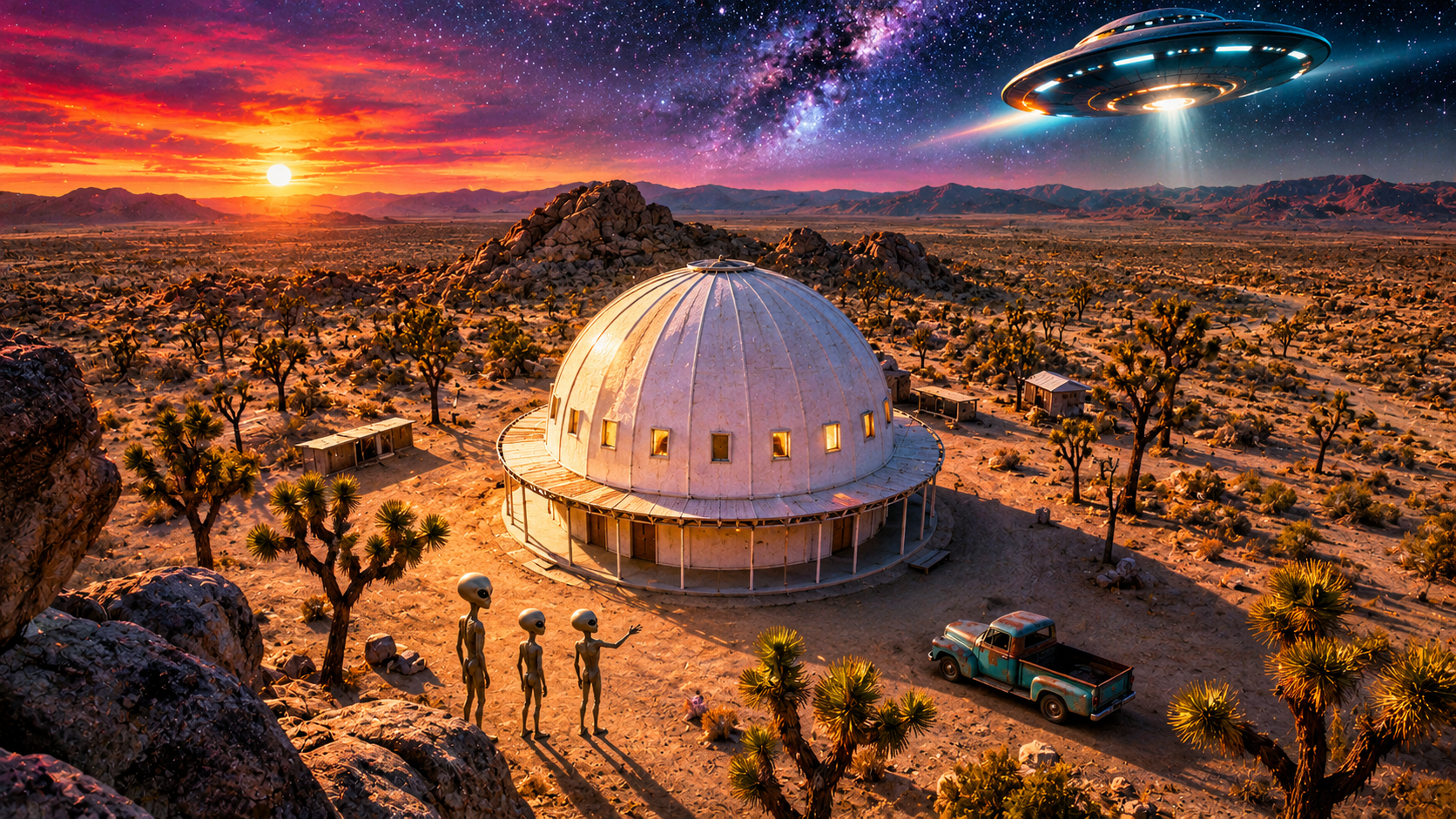
Well, no evidence establishes that extraterrestrials had anything to do with the Integratron.
Van Tassel’s alleged encounter with Solgonda remains a personal claim, not a verified historical event.
And the machine’s proposed rejuvenation technology never achieved demonstrated scientific success.
Those distinctions matter.
The desert has enough genuine mysteries without inventing evidence for new ones.
But dismissing the entire story as nonsense would miss something important.
George Van Tassel was a real man who built a real structure in pursuit of an extraordinary belief. His gatherings helped establish Giant Rock as a landmark in American UFO culture. And the building he left behind continues attracting visitors who might otherwise never have heard his name.
That’s an unusual legacy by anybody’s standards.
Maybe Van Tassel never received instructions from Venus.
Maybe the Integratron was never going to reverse aging.
Maybe the whole enterprise was an elaborate monument to humanity’s capacity for believing impossible things.
But consider this.
A man went into the desert, claimed he’d met someone from another planet, and spent decades trying to build a machine that would change the nature of human existence.
Nearly five decades after his death, people are still making pilgrimages to see what he created.
For a machine that never conquered time, that’s a pretty impressive way of surviving it.
And somewhere out beyond Giant Rock, beneath a sky so crowded with stars it almost seems unreasonable, the Mojave continues doing what it does best.
Making the impossible feel just a little less impossible.
Stay weird, desert people.
— Dusty Oddity
Editor’s note: This article draws on documented local history and George Van Tassel’s own accounts. His alleged extraterrestrial encounters and rejuvenation theories have not been scientifically verified. The Integratron is a historic structure, not a scientifically demonstrated time machine.


Leave a Reply